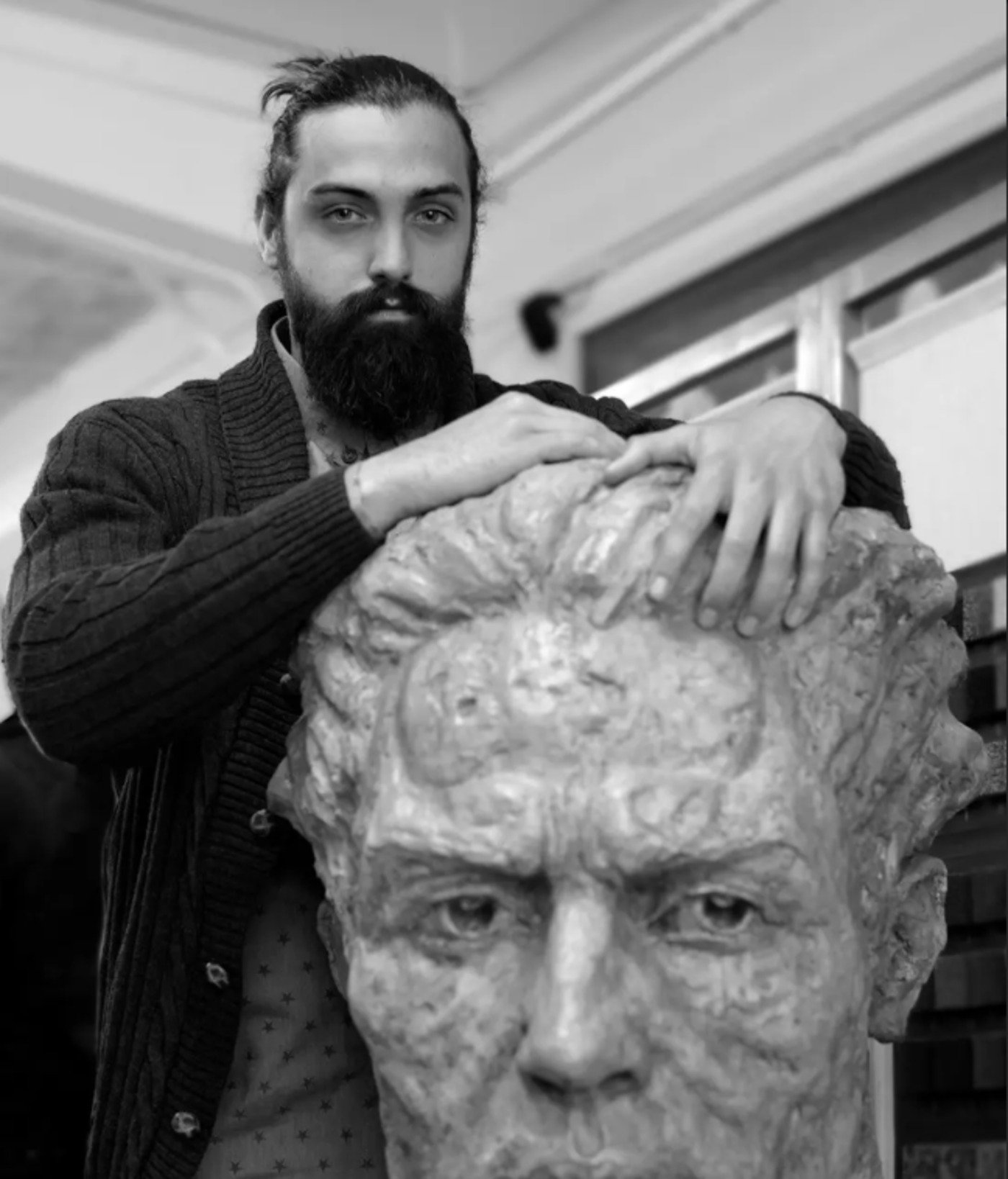
Faura Balsa, born in A Coruña in 1991, is a figurative sculptor whose style stands out for combining the rigor of academic tradition with a contemporary sensibility. His works, created primarily in clay, reflect a balance between formal perfection and emotional expressiveness, allowing each piece to convey a profound story or sentiment.
Trained at the Pablo Picasso School of Art, the Barcelona Academy of Art, and various artisan workshops, Faura has developed his own artistic language, exploring both anatomy and symbolic narrative with an attention to detail that highlights the strength and delicacy of his figures.
His work is born from a need: to recover the human figure as a site of meaning.
He works within the tradition of figurative sculpture, but he is not interested in reproducing it as a language of the past. What interests him is what still remains alive within it: the capacity of a figure to embody an idea, a conflict, a belief, or a story.
The body is his primary instrument. Through it he explores strength and fragility, violence and sacrifice, dignity, death, and transcendence. He is particularly drawn to figures that seem to exist at a threshold: heroes before battle, bodies after combat, saints confronting their fate, characters suspended between the earthly and the spiritual. His imagery draws on classical tradition and European sculpture, but also on the Middle Ages, mythology, literature, and epic traditions. He does not seek to reconstruct these worlds or turn them into nostalgia for the past — he uses them as symbolic territory from which to speak about the present.
He believes sculpture holds something that the contemporary image has lost: presence. A figure occupies real space, casts a shadow, carries weight, ages, and compels the viewer to physically share that same place. This material dimension is fundamental to his work.
This is why he defends the craft and the time it demands. Modeling, observing, correcting, and rebuilding are inseparable parts of the work. The mark of the hand is not an accident of process — it is the record of that confrontation between artist and material.
In an age of fast, disposable images, he aspires to make sculptures that demand time.
Figures that do not simply represent someone, but seem to have survived something.
Works that belong to the present, but that might be recognized a hundred years from now.